How to Work Through DeltaMath Trigonometry With Confidence
Learn how to work through DeltaMath trigonometry with confidence: the unit circle, identities, graphing, and where to get step-by-step trig help.
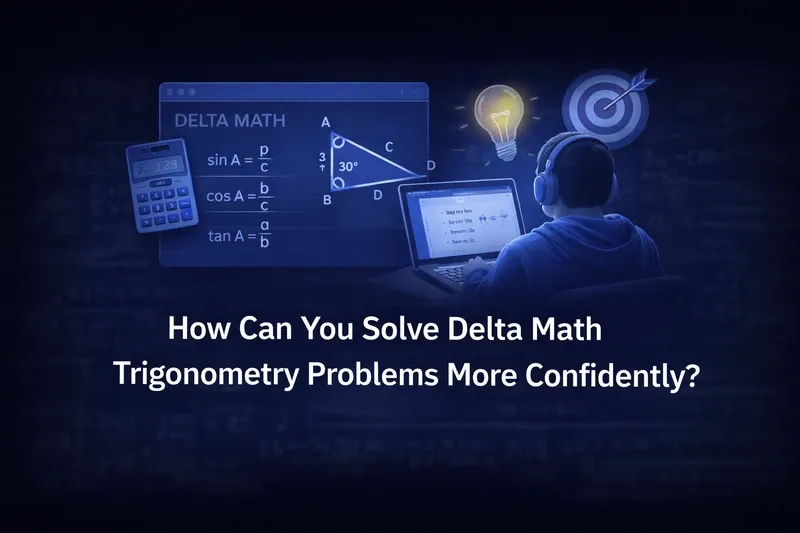
DeltaMath Trigonometry is a visual reasoning problem that involves algebraic manipulation and heavy memorization (DeltaMath. 2020). Students looking for help with DeltaMath trigonometry are often overwhelmed by the unit circle, identity proofs, and graphing that demand the use of exact values in the correct formats. The positive thing is that trig is regularly patterned. This guide covers the core problem types and the methods for working through them with confidence.
Mastering the Unit Circle
In the unit circle, almost all the trig problems in DeltaMath are based. We cannot have it, without having something else clicking.
Memorize Key Angles and Coordinates
The sine and the cosine values of 0deg, 30 deg, 45deg, 60 deg, 90 deg and their radian counterparts. The tests of these are found in DeltaMath in Find Coordinate on Unit Circle and Exact Trig Values Graphically. The sine of the first quadrant is 0, 1/2, [?]2/2, [?]3/2, 1 and Cos is the reverse. after knowing quadrant one, there are sign rules over the others..
Reference Angles and Quadrant Signs
Tests with DeltaMath use reference angles in finding reference angles and finding coterminal, reference, and quadrant. All angles outside quadrant one are a reference angle ranging between 0deg and 90deg. The mnemonic All Students Take Calculus is a way of memorizing which functions are positive in each quadrant, working with any angle (you do not need any additional memorization).
Solving Right Triangle Problems
The first course on DeltaMath and the simplest one should you recall your ratios is right triangle trig.
SOHCAHTOA Applications
S= SOH, C= SOH, T= SOH. DeltaMath asks you to find missing sides or angles using these ratios. It is all about identifying correctly the sides opposite and adjacent to the angle.
Inverse Trig Functions for Missing Angles
In cases where DeltaMath requires an angle of the form (a -b)/c, the inverse formulas should be used. If sin(x) = 0.5, then x = sin-1(0.5) = 30deg. Certain issues require precise values and others indicate rounding. Always read the instructions before you enter anything.
Working With Trigonometric Identities
Most students find identities the hardest part of DeltaMath trigonometry, because the problems call for creativity rather than a fixed algorithm.
The Essential Identities to Know
Remember sin 2 x +cos2x=1 and its derivations. Reciprocal identities Useful in knowing sine cosecant, cosine secant, tangent cotangent. The tan x = sin x /cos x and cot x = cos x /sin x identities make up the set. The DeltaMath tests your skills in working with expressions with them.
Strategy for Proving Identities
Begin with the complicated part and reduce to the basic part. Everything can be converted into sine and cosine and patterns can be unraveled. Factor, combine and/or use pythagorean substitutions. Similar reasoning is done with identity proofs read How To Understand Step-by-step Geometry Proofs in Delta Math to that effect.
Graphing Trigonometric Functions
The DeltaMath graphing math problems not only call upon accuracy far beyond knowing the shape of a curve.
Amplitude, Period, and Phase Shift
DeltaMath asks you to identify or graph transformed functions. The absolute value of the coefficient is known as amplitude. Period = 2/B p of A sin(Bx + C) + D Phase shift = -C/B vertical offset = D To graph correctly in DeltaMath trigonometry, compute each parameter separately.
Plotting Points Accurately on DeltaMath
The graphing tool will not tolerate errors related to point placement inexactly. Mark the endpoints of plot, highs, lows and the midline crossovers. DeltaMath verifies these anchor points hence precision is of greater importance than a smooth curve.
Solving Trigonometric Equations
Trig equations are a combination of unit circle, identities, and manipulation of algebra.
Isolate the Trig Function First
Take the trig as a dependent variable. In case, 2sin (x)-1 =0, put it aside and then use the unit circle to work with all angles covering the specified interval. Missing a valid solution counts against you just as much as including an invalid one.
Watch for Extraneous Solutions
Squaring both sides or applying identities can introduce invalid solutions. To verify, substitute each solution back into the original equation. An extraneous solution has the effect of resetting your streak.
Tools for Building Trig Confidence
The right support helps you understand where your reasoning or formatting goes wrong.
Use Step-by-Step Explanations
SkipDelta's trigonometry help walks through each type of trig problem step by step, with the reasoning explained. You see exactly how each problem should be approached instead of guessing.
Build Skills Incrementally
Unit circle drills should be started before identities. Master right triangles and then master graphs. The topics are connected and following without any gaps. The daily habit of doing even 10 problems will make it easier to achieve fluency than the cramming habit.
Conclusion
Working through DeltaMath trigonometry with confidence comes down to mastering the unit circle and the identities, and having a set of strategies to follow. Once you've learned them, the patterns become predictable. Step-by-step explanations from SkipDelta can help you see those patterns and build the skills for any assignment.
Frequently Asked Questions
Is there a fixed key I can study from for DeltaMath trigonometry?
No. DeltaMath randomizes each problem, so there is nothing fixed to memorize. Worked examples, such as DeltaMath's Show Example or a step-by-step explanation of your own problem, teach the method so you can apply it to the next one.
What is the hardest trigonometry topic on DeltaMath?
Identity proofs and trig equations are most difficult to other students as they demand inventive manipulation as opposed to fixed formulae. Graphing using phase shifts takes the second place because of the fine click requirements.
Why does DeltaMath mark my trig answers wrong when the math is right?
DeltaMath requires exact formatting. Any approximations with actual values, any measurements in degrees rather than radians, and any unsimplified form, all will be considered wrong. Adjust to the format that is given in the problem.
How many unit circle values do I need to memorize?
Sine and Cosine are required of 5 first-quadrant angles, namely, 0deg, 30deg, 45deg, 60deg, and 90deg. These, together with reference angles and quadrant sign rules, let you find the values for any standard angle in DeltaMath trigonometry.
Where can I get reliable step-by-step help with DeltaMath trigonometry?
Use help that works on your own randomized problem and shows each step in DeltaMath's format, such as SkipDelta's trigonometry explanations. That teaches you far more than a generic worksheet key.